

Ensuring Tight Seal Tolerances
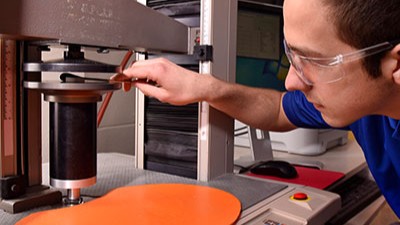
For maximum performance, rubber seals must be extruded to highly precise dimensional tolerances. Maintaining accuracy in part thickness, width, radius and other properties is vital in ensuring fluids are locked in and unwanted environmental factors are kept out. Here are just some of the ways we at Cooper Standard ISG ensure that precise dimensional tolerances are maintained on every seal, every time:
- Decades of extrusion data and expertise
- High-quality, consistent raw materials
- Custom, in-house extrusion tooling
- Expertly considered curing processes
It all starts with materials
Our extrusion processes are fine-tuned, closely monitored and adjusted as needed. However, even the most perfect extruding process will produce subpar results if the input is ill considered. It is imperative that processes start with high quality, consistent raw materials.
The biggest threat is material inconsistency. For example, variation in the feedstock, flow rates and melt profiles can impact dimensional accuracy. Powders or fillers must have a consistent distribution in particle size and particle shape throughout.
We carefully vet and often audit our suppliers to ensure checks and balances in the mixing operation, looking for as much automation in the process as possible to eliminate potential human error.
We go above and beyond demanding a Certificate of Analysis from suppliers, examining the underlying data ourselves. How does the test data compare to historical data? Do the trends in the data show a process that is in or out of control? What are our leading indicators of production performance? Is there a trend we should be on top of? Being proactive is an important way to maintain quality flow of raw rubber for high quality, high precision seals.
The most accurate dies, made to order
Nearly as important as the quality of the raw rubber is the quality of the die. Our in-house die shop allows us to create optimum tooling for every sealing project. The flow characteristics of polymeric materials are key to maintaining dimensional tolerances and the overall quality of the part, and that is based strongly on temperature. Precise heat must be applied and distributed properly across the die to avoid fast, slow or hot spots. Design skill is crucial to compensate for varied material flow. Keeping extrusion and toolmaking operations in close proximity where they can collaborate and share knowledge provides a huge advantage that would be lost by engaging an outside, third-party die maker. Leveraging an in-house die shop also allows us to significantly reduce lead times and deliver finished seals to our customers faster than extruders who rely on third-party tooling.
Select the optimum cure medium, not just “the one we have”
Optimal heat curing is vital to achieving the desired dimensions of the seal. There is no one-size-fits-all when it comes to curing. High-quality extruders are masters of many curing options and choose cure media strategically to provide the tightest dimensional tolerances possible.
There are also many different cure processes to choose from. At Cooper Standard ISG, we use technologies such as molten salt, hot air, microwave radiation, fluidized beds and infrared radiation, as well as variations within each technology, to select among for the best results.
A less experienced extruder might default to using microwave hot air, for example, just because it’s the latest technology. But no single cure media is optimal for every part. The most valuable extruders can identify the best technology for every use-case.
Further, no matter what technology is chosen, expertise in using it is also vital. Heat must be carefully controlled and introduced into the material at the proper moment during the extrusion process so that the seal not only cures fully, but evenly as well. There is no substitute for experience.
Maintain tight product quality control downstream
In addition, the extrusion process should be constantly monitored in real time, and extruders must work to correct even slight fluctuations before they become problematic. Our quality assurance procedures include processes programmed to detect and warn of parameters falling outside of tolerances and gather an intermittent sample collection throughout production to ensure products remain within dimensional tolerances. AI-driven tools make processes such as these even more effective today, and Cooper Standard ISG has invested heavily in these cutting-edge technologies to eliminate any opportunity to create bad product and waste.
Dimensions should be measured before product goes out the door, with the results reported to customers, but that data should also be archived and studied to investigate trends over time. In an industry that can tend to become entrenched in legacy reporting systems, we at Cooper Standard ISG have decades of digitally archived and analyzed extrusion data. Such a database is invaluable when it comes to troubleshooting issues and continually improving our processes.
These are just a few of the ways that a Cooper Standard ISG seal development partnership can help deliver seals with optimum dimensional tolerances for every project, helping ensure outstanding long-term product performance.